


Salt, Nor’easters & Wind Load: Selecting Exterior Cladding That Survives Coastal Maine 🌊💨
Few settings rival the rugged beauty of Coastal Maine. Watching storm swells roll across Frenchman Bay or taking in the morning fog over Mount Desert Island from your living room makes building here extraordinary.
Living along the water also means your home faces some of the most unforgiving weather in New England. Between sustained 60-plus mph gale winds during winter nor’easters, relentless salt fog, and driving wind-driven rain, your exterior cladding is not just an aesthetic choice. It serves as your primary defense against moisture intrusion and structural rot.
When designing a custom home in Hancock County or surrounding coastal regions, selecting siding requires balancing authentic New England architectural character with coastal engineering.
Here is what seasoned custom builders evaluate when engineering an exterior envelope built to endure generations on the Maine coast.
1. The Rainscreen Principle: Why Siding Alone Won’t Keep Water Out 🌧️
Many homeowners assume exterior siding functions as a completely waterproof shell. On an exposed coastal headland, no surface material remains entirely watertight against sustained, wind-driven moisture.
Water will eventually push through joints, nail penetrations, and overlap edges. The real goal is controlling what happens to that water once it gets behind the cladding.
Standard residential construction often nails siding directly against a water-resistive barrier (such as standard building wrap) attached to plywood sheathing. In a sheltered subdivision, that assembly can suffice. On an open coastal point, trapped moisture between the back of the siding and the house wrap cannot dry out. Over time, that dampness causes paint failure, premature siding cupping, and wall-cavity wood rot.
A rainscreen wall system solves this problem:
Intentional Air Cavity: We install vertical furring strips or a three-dimensional drainage mat between the house wrap and the siding, creating an unobstructed capillary break (typically 3/8" to 3/4").
Gravity Drainage: Any moisture that penetrates the cladding drops harmlessly down the air gap and exits through weep screeds at the bottom of the wall.
Continuous Convective Drying: Natural airflow enters at the bottom of the wall cavity and vents out near the soffits, drying both the exterior cladding and the inner wall sheathing year-round.
Investing in a properly detailed rainscreen assembly behind your siding protects your wall framing, keeps indoor air dry, and preserves the lifespan of your exterior finish.

2. Comparing Coastal Cladding Materials: Aesthetic vs. Longevity 🏡✨
Achieving the quintessential coastal New England look does not require choosing high-maintenance materials. Multiple exterior cladding options offer strong performance along coastal waters:
Cladding Material | Architectural Character | Salt & Wind Durability | Ongoing Maintenance |
Eastern White Cedar Shingles 🌲 | Classic weathered-silver coastal shingle-style aesthetic | Excellent natural rot resistance; flexible under high wind loads | Low if left unstained to weather naturally; moderate if sealed |
Western Red Cedar Lap Siding 🪵 | Warm, refined luxury profile with rich grain patterns | High resistance to decay; vulnerable to surface erosion if unsealed | High; requires periodic restaining or resealing against salt air |
Engineered Wood (Strand-Core) 🛡️ | Clean lines, crisp shadow lines, authentic wood look | Exceptional dimensional stability; resists moisture expansion | Low; factory finishes often carry multi-decade coating warranties |
Standing-Seam Metal Accents 🏗️ | Contemporary coastal edge; sharp, clean architectural lines | Impervious to driving wind and moisture; non-combustible | Extremely low; requires corrosion-rated coastal alloy coatings |
White Cedar Shingles: The Coastal Standard 🌊
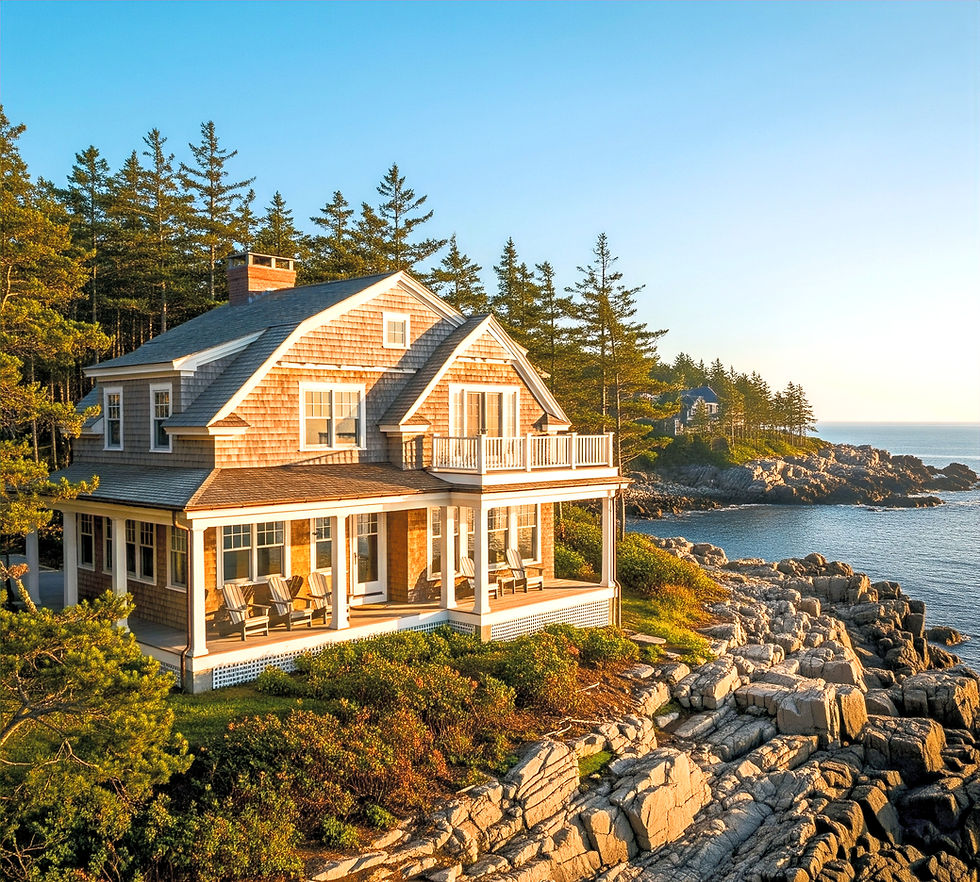
Natural Eastern white cedar shingles remain an architectural staple throughout Maine for good reason. Packed with natural tannins that resist rot, cedar shingles handle cyclical wetting and drying gracefully. Left untreated, they age into that soft, silvery-gray patina synonymous with coastal estates. When dipped in exterior stain prior to installation, all six sides stay protected against early salt absorption.
Engineered Wood Siding 📐
For homeowners who prefer crisp lap siding or board-and-batten aesthetics without natural wood movement, high-end engineered wood siding stands out. Formulated with water-resistant waxes, zinc borate preservatives, and resin binders, high-performance engineered lap siding resists fungal decay, termites, and hail impact while holding factory-applied paint significantly longer than traditional pine.

3. Fasteners and Flashing: Where Coastal Envelopes Fail 🔩🛡️
A siding product performs only as well as the fasteners securing it to the studs.
Inland homes frequently use electro-galvanized or hot-dipped galvanized nails. Along coastal waters, salt-laden ambient air corrodes standard galvanized coatings surprisingly fast. Once corrosion begins, two issues follow: unsightly black rust streaks bleeding down your siding, and compromised fastener shanks that risk blowing off during severe wind events.
Building along the Maine coast requires strict hardware specifications:
316 Marine-Grade Stainless Steel Fasteners: Standard 304 stainless steel works well inland, but salt fog within a couple miles of open saltwater demands Grade 316 stainless fasteners to eliminate coastal pitting and chemical oxidation. ⚓
Self-Adhered Flexible Flashing Membranes: We install heavy-duty butyl or advanced vapor-permeable flashing tapes around all window rough openings, outside corners, and door thresholds, creating a continuous seal that flexes with temperature extremes without cracking. 🪟
Corrosion-Resistant Metal Kickout Flashing: Where roof lines intersect vertical walls, custom-bent kickout flashing directs torrents of roof runoff safely away from siding assemblies and into gutter systems. 📐
4. Architectural Geometry: Deflecting High Wind Loads by Design 📐🧭
Exterior protection begins in the initial design phase. Using industry-standard design and building software, structural layouts can be tailored to minimize wind resistance before excavation begins.
Hip Roofs Over Gable Ends: While gable profiles remain charmingly traditional, steep hip roof profiles naturally deflect wind upward and over the structure from all four directions, reducing the uplift force that nor’easters place on eaves. 🏠
Deep, Protected Overhangs: Well-engineered soffits protect upper-story wall assemblies from direct wind-driven rain, provided the soffit framing is securely tied into rafters to withstand upward wind pressure. 🌧️
Impact-Rated Glazing Transitions: Coastal windows demand structural design pressure (DP) ratings capable of resisting wind flex. Siding transitions around wide-span glass walls must include custom-milled drip caps to keep water from pooling along upper window casings. 🔍
Superior Quality, Efficiency & Function from the Ground Up ⚓
Building an heirloom coastal home in Maine is an investment meant to be enjoyed without the stress of constant exterior upkeep. By pairing architectural balance with proper rainscreen dynamics, marine-grade hardware, and resilient cladding materials, you secure a home that remains quiet, dry, and structurally sound through every seasonal storm.

Planning a custom home or major coastal renovation in Downeast Maine?
👉 Schedule a Consultation with Generations Custom Homes to explore building a home tailored for life along the water. 🏡✨


Comments